Posts

A Jim Kjelgaard Bibliography — The Books

Image
A Jim Kjelgaard Bibliography: The Books     Forest Patrol (Holiday House, 1941 / illustrated by Tony Palazzo) Rebel Siege (Holiday House, 1943 / illustrated by Charles Banks Wilson) Big Red (Holiday House, 1945 / illustrated by Bob Kuhn) Buckskin Brigade (Holiday House, 1947 / illustrated by Ralph Ray, Jr.) Snow Dog (Holiday House, 1948 / illustrated by Jacob Landau) Kalak of the Ice (Holiday House, 1949 / illustrated by Bob Kuhn) A Nose for Trouble (Holiday House, 1949) Wild Trek (Holiday House, 1950) Chip, the Dam Builder (Holiday House, 1950 / illustrated by Ralph Ray, Jr.) Irish Red (Holiday House, 1951) Fire-Hunter (Holiday House, 1951 / illustrated by Ralph Ray, Jr.) The Explorations of Père Marquette (Random House, 1951) Trailing Trouble (Holiday House, 1951) The Spell of the White Sturgeon (Dodd, Mead, 1953) Outlaw Red (Holiday House, 1953) The Coming of the Mormons (Random House, 1953) Cracker Barrel Trouble Shooter (Dodd, Mead, 1954) Haunt Fox ...


Jim Kjelgaard's Arizona Home

Image
  1238 Palo Verde Drive in Phoenix, Arizona, was Jim Kjelgaard’s home from about 1952 until his death on July 12, 1959. Kjelgaard had been suffering from back pain, which was a lifelong ailment, and what his daughter, Karen, called “incipient arthritis” and so for health reasons the family moved to Arizona from their home in Thiensville, Wisconsin. Thiensville was a small farming community north of Milwaukee and quite close to Lake Michigan.     Kjelgaard had a small office in their Phoenix home and wrote many of his best-known novels there, including, Lion Hound (1955), Desert Dog (1956), Wolf Brother (1957), Stormy (1959), and his two adult novels, The Lost Wagon (1955) and The Land is Bright (1958). Karen, in an essay, wrote: “As I grew up in Phoenix, I became more aware of how hard my father worked. It was not unusual for him to spend the entire day in his office, typing with two fingers on his old manual typewriter, then eat supper and go back to writing.”...

Quotes... from Big Red

Image
 

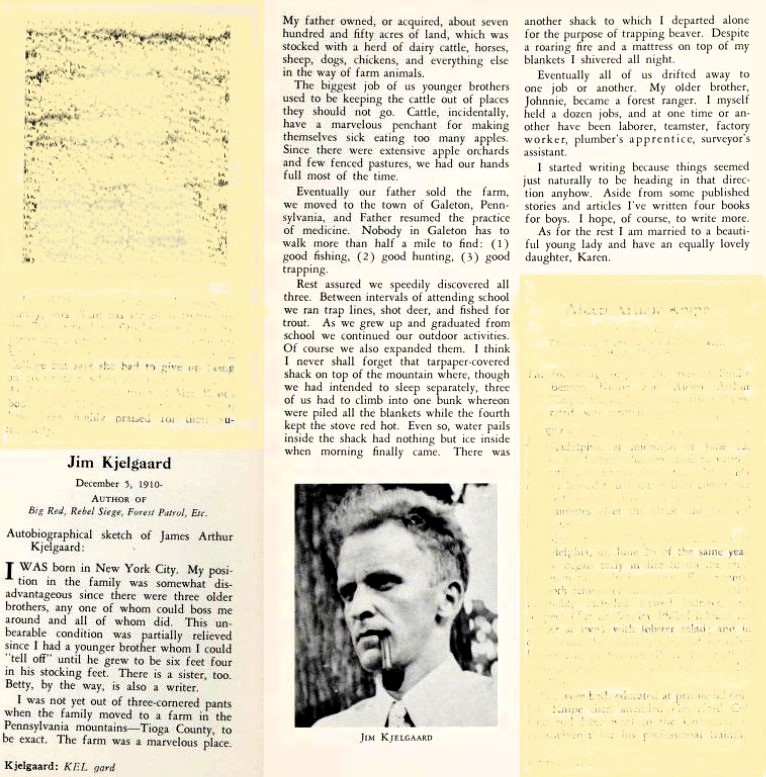
Autobiographical Sketch of Jim Kjelgaard

Image
This autobiographical essay by Jim Kjelgaard appeared in The Junior Book of Authors – Second Edition, Revised – edited by Stanley J. Kunitz & Howard Haycraft (H. W. Wilson Co., 1951). Kjelgaard notes, in the final paragraphs of the article, that he had “written four books for boys,” which makes me think the article was written between the publications of Buckskin Brigade  (1947) and Snow Dog (1948).    

What They Said... "Wildlife Cameraman"

Image
  What they said…   Wildlife Cameraman   llllll   Wildlife Cameraman  appeared in hardcover from New York’s Holiday House in April 1957. It was the first of four of Kjelgaard’s books to be illustrated by Sam Savitt. The others, all published after Kjelgaard’s death in 1959, were:   Fawn in the Forest and Other Animal Stories  (1962), Two Dogs and Horse (1964), and  Dave and His Dog, Mulligan  (1966). Kjelgaard’s twenty-second novel,  Wildlife Cameraman   received exceptional reviews across the industry, including a starred review from  Kirkus , calling it “[s]harply focused” and “[capturing] all the thrills and satisfactions, even of photography’s more routine moments, and, in the Kjelgaard manner, attaches them to a tight plot closely related to the technique involved.” The write-up, from the Nov. 1957 issue of  Children’s Digest , for Wildlife Cameraman is below.    

Review: "Fire-Hunter" by Jim Kjelgaard

Image
Fire-Hunter by Jim Kjelgaard Illustrated by Ralph Ray, Jr. Holiday House, Sep. 1951 Jim Kjelgaard’s eleventh novel, Fire-Hunter , is a fast-paced pre-historic adventure. Hawk, the Chief Spear-Maker of his tribe, is banished for defying tribal law and using a spear-thrower during a wooly rhinoceros hunt. He, along with a girl called Willow left behind by their hunter-gatherer tribe because of a leg injury, seem doomed as they must survive alone. Their survival depends on their ability to hunt smaller, more agile, game that are inaccessible to their tribe because the larger game—wooly rhinoceros, bison—are too large and deadly for them to hunt alone.     Their defense is precarious, too, since Hawk can carry only a club and two large spears. Hawk’s desperation and curiosity lead him to adapt his weapons from throwing spears to a catapult-like spear thrower, what I’ve always thought of as an atlatl, to an early form of a bow. Willow does her share, too, helping Hawk understan...

A Little About... "Rebel Siege" by Jim Kjelgaard

Image
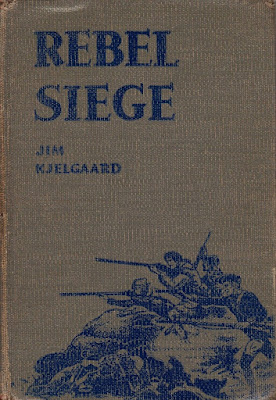
  A Little About…  Rebel Siege Jim Kjelgaard’s second novel, Rebel Siege , appeared in September 1943 from Holiday House, a full two years after his first novel, Forest Patrol , was published. It was the first of two Kjelgaard novels illustrated by Charles Banks Wilson. The other, The Story of Geronimo , was published by Grosset & Dunlap in 1958. Wilson is most famous for his portraits of Will Rogers, Jim Thorpe, and U.S. House Speaker Carl Albert, which is hanging in Washington D.C.’s National Portrait Gallery.      While Forest Patrol is like the books Kjelgaard is best known for—animals, boys, and wild places— Rebel Siege is a historical novel about a fourteen-year-old boy, Kinrose McKensie, and his experiences in the American Revolutionary War. Largely set in South Carolina, Rebel Siege , chronicles Kin’s war—including losing his rifle to a British soldier and dealing with his Tory father—all the way to the British surrender at Kings Mountain. Kirkus...